


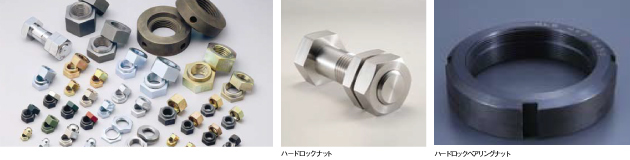
Hardlock nuts utilize a wedge, a technique used in traditional Japanese wooden architecture, to eliminate play in the "fitting thread portion."
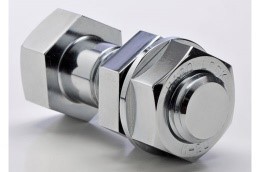
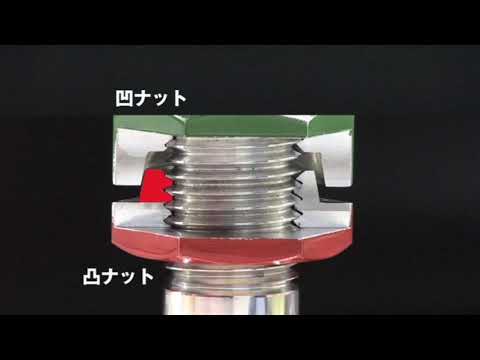
It consists of two types of nuts, one with a protruding and one with a concave shape. The wedge-shaped, eccentrically machined convex nut, which acts as the tightening nut, is tightened first, and then the perfectly round concave nut, which acts as the locking nut, is placed over it and tightened. This causes the entire threaded portion of the convex nut to be pressed against the bolt, while the entire threaded portion of the concave nut is pressed against the bolt thread on the opposite side.
- TOP
- Visiting the permanent exhibition hall
- Hardrock Industries Co., Ltd.
Exhibition booths: 81, 82
Hardrock Industries Co., Ltd. Hard Rock Kogyo
President and Representative Director
Masahiko Wakabayashi
Main products
Locking screws
Hardlock Nut
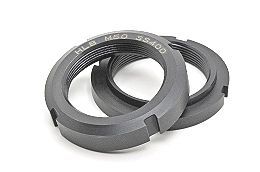
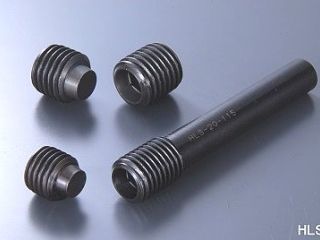
Hardlock bearing nuts, Hardlock set screws
Business content
Hardlock Industries Co., Ltd. manufactures and sells locking nuts, an invisible yet indispensable part that plays a vital, behind-the-scenes role in ensuring safety. Hardlock Industries' production concept is "Safety is Power!" and that will never change.
Product and Technology Introduction
Product and Technology Introduction
Why don't hard lock nuts loosen, and why are they necessary?
A wedge structure that eliminates play in the "fitting screw section"
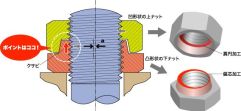
By eliminating the play in the threaded portion of the nut from both sides, a robust anti-reverse rotation is achieved.
Screw with "no reverse rotation"
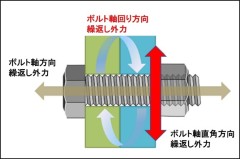
Repeated external force perpendicular to the bolt axis
Hardlock nuts lock completely with nuts that have different textures. Therefore, even when subjected to repeated external forces perpendicular to the bolt axis, which are said to "always loosen any screw fastener," the screw will not rotate backward.
Furthermore, because it can maintain its initial tightening force for an extended period, it is a product with unparalleled performance worldwide.
We've also expanded to bearing nuts and set screws.
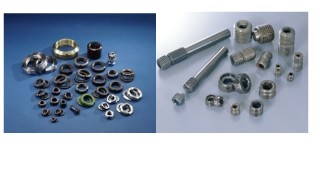
Hardlock bearing nuts, hardlock set screws
The bearing nut was developed as a locking nut for bearings.
Its high anti-loosening effect ensures a stable and perfect fastening state, unaffected by vibrations from high-speed rotation or shocks from forward and reverse rotation, enabling significant cost reductions through maintenance-free operation.
Furthermore, an innovative application of this technology to hex socket set screws is the self-locking set screw, which is mainly used to secure the casting pins in molds.
Detailed information is available on the "Delivery Record" page (see the bottom of the page for the URL).
Case study: Vertical articulated robot axis (joint) fixing
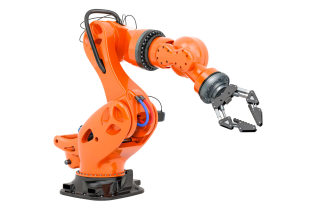
Fastening points of a vertical articulated robot
Product: Hardlock Bearing Nut
Vertical articulated robots have joints similar to those in human shoulders, elbows, and wrists, allowing them to perform complex movements just like a human arm. Many vertical articulated robots have six axes of articulation, and in principle, six axes are sufficient to cover a full range of hand position and orientation.
The more axes there are, the more different postures can be adopted, increasing versatility.
1) Places of employment
- Locations where bearings are fastened with low axial force
- Sections that repeatedly perform forward and reverse rotation movements
2) Improvement
- It enabled fastening in areas where smooth movement is required and where low axial force fastening is necessary.
• Maintenance cycles have been significantly extended, resulting in longer operating hours and improved productivity.
Case study: Fastening of hook bolts for securing railway ties on a bridge.
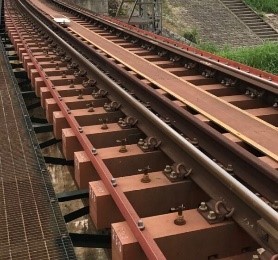
Fastening of hook bolts for securing sleepers on a bridge.
Product: Hardlock Nut
The railway tracks on bridges are ballastless (without ballast or slabs), and when a train passes over them, the impact load and vibration from the vehicle are concentrated on the fasteners. Hook bolts are used to secure the sleepers to the bridge girders.
1) Places of employment
- Areas that are subjected to impact loads and vibrations from the train
- Railway sleepers are designed to sag to absorb impact, and therefore cannot be tightened too tightly in certain areas.
- The detachment of parts is a dangerous area that could lead to personal injury to people below the bridge.
2) Improvement
- The burden of inspection work during nighttime inspections has been significantly reduced.
• The problem of parts falling due to loosening has been eliminated, resulting in improved safety.
A website providing engineers with secure and reliable contract signing solutions.
Detailed information is available on "Screw Fastening Technology Navi" (see the bottom of the page for the URL).
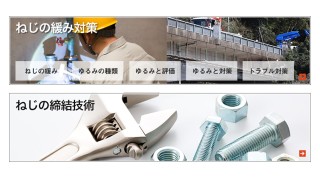
Top screen of "Screw Fastening Technology Navi"
A technical information site about screws in general and loosening.
Engineers facing challenges with screw fastening should obtain specialized technical information, including the following, from "Screw Fastening Technology Navi."
- Loose screws
• Design and tightening of screw fasteners
・About screws
Screw troubles
• Download materials
"The world's strongest hard lock nut" contributes to ensuring the safety of social infrastructure with its exceptional reliability.
Active in all areas of society where safety is the top priority.
Hardlock Nuts, Hardlock Industries' flagship product, are used in virtually every part of society where safety is paramount, including Shinkansen bullet trains, railway tracks, large bridges such as the Akashi Kaikyo Bridge, highways, nuclear power plants, communication towers, and ships.
In 1961, while working as a valve engineer, the company's president, Wakabayashi, developed the "U-nut," a nut with excellent anti-loosening properties. This was the predecessor to the current Hardlock nut.
The U-nut became a huge hit, but when installed in construction sites with a lot of vibration, the nuts would sometimes loosen, leading to some complaints. So President Wakabayashi began developing a nut that would "never loosen even with vibration."
As a result of research, the Hardlock Nut was developed in 1973. Its structure is inspired by the wedge, an ancient Japanese construction technique. Instead of driving a wedge into the gap between the nut and bolt, it uses a system that combines two nuts: a convex lower nut and a concave upper nut. Because the central axis of the convex nut is slightly offset, when the upper and lower nuts are combined, it creates a strong tightening effect similar to driving a wedge. It also boasts excellent workability, as it can be easily installed and removed.
"Safety is power" as our weapon, spreading throughout Japan and the world.
The company president founded Hardlock Industries in 1974, the year after developing the product. Since then, as mentioned above, Hardlock nuts have been adopted in various places in society. Aside from installation errors such as forgetting to tighten the nuts, there have been no reports or complaints of "loose nuts" even now, more than 35 years after the product's inception.
Currently, the product range has been expanded to include bearing nuts (HLB - Hardlock Bearing Nut), single type (Spacelock Nut), mold clamping screws (HLS - Hardlock Set Screw), and rim-equipped type (Hardlock Rim).
The company's future goals are further quality improvement and expansion of sales channels. "Hardlock nuts seem to have the image of being 'special nuts' used in railways and the like, but only about 20% of our deliveries are to railways. We want to propose that these safe nuts be used in a wider range of places," says President Wakabayashi.
Furthermore, Hardlock Nuts are highly regarded and widely adopted not only in Japan but also in countries around the world, including Taiwan, South Korea, the United Kingdom, and Poland. True to its product slogan, "Safety is Power," the company aims for even wider adoption, building on the trust it has cultivated so far.
Our selling points
Please use Hardlock nuts, which offer superior safety and economic benefits.
Hardlock nuts come in sets of two nuts with interlocking protrusions, making them slightly more expensive than regular nuts. However, their semi-permanent anti-loosening effect eliminates the need for maintenance after installation, and they can withstand repeated use. Ultimately, hardlock nuts contribute to reducing overall costs, making them the most economical type of nut.
Main business activities
Manufacturing and sales of anti-loosening nut products (Hardlock nuts, HLB - Hardlock bearing nuts, etc.)
Main customers (delivery destinations)
Construction companies, railway companies, industrial and machine tool companies, power companies, shipbuilding and heavy machinery companies, etc.
Company profile
- Company name
-
Hardrock Industries Co., Ltd.
- address
-
1-6-24 Kawamata, Higashiosaka City, Osaka Prefecture 577-0063
- representative
-
Katsuhiko Wakabayashi
- Founding year/Establishment year
-
1974 / 1977
- telephone number
-
06-6784-1131
- FAX number
-
06-6784-1161
- Company website
-
● Delivery record (https://hardlock.co.jp/applications/)
●Screw fastening technology guide (https://navi.hardlock.co.jp/)
President's interview article (2017)https://note.com/mobio_osaka/n/n53c9cf97f49c)
- capital
-
10,000,000 yen
Top 100 Thriving Manufacturing Companies in Kansai (FY2009)
300 thriving small and medium-sized manufacturing companies (FY2009)
Japan Manufacturing Grand Prize (FY2009)
Patented, ISO9001 certified, JISQ9100 certified